Due to our shipping policy, each order is limited to 1 item. If you would like to purchase multiple items, please place separate orders.
MIDI CONTROLLER / FM SYNTH
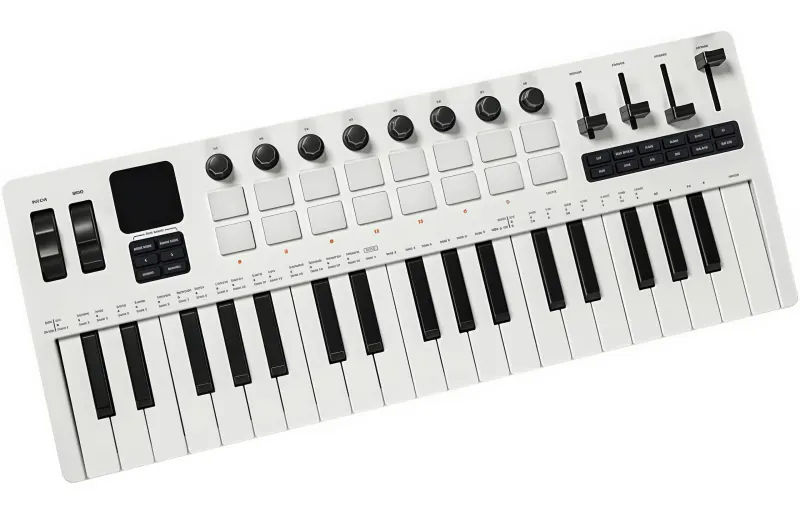
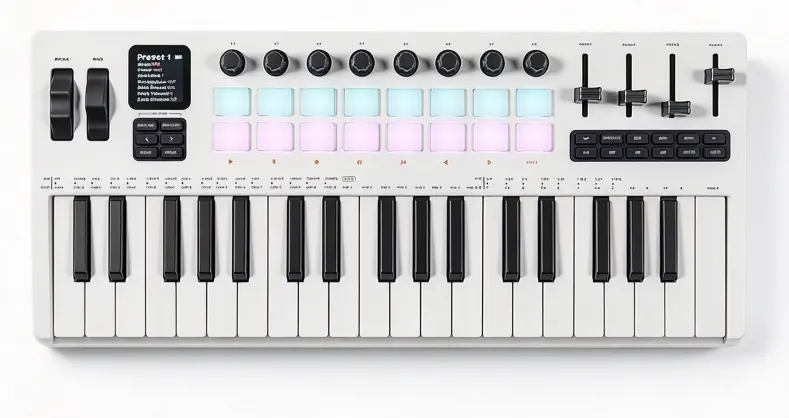
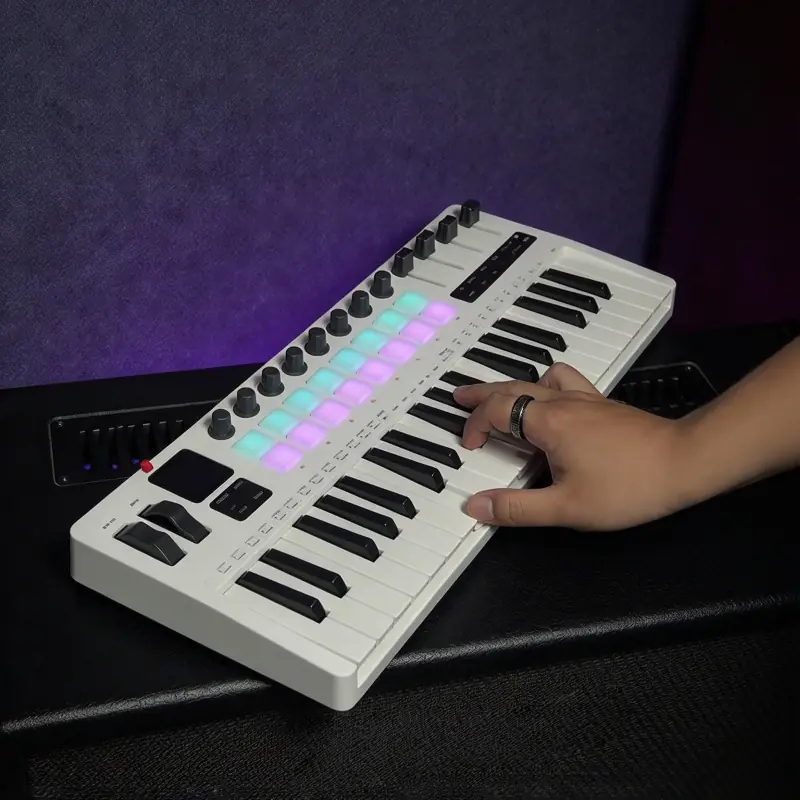
37 keys. 16 pads.One cable.
A three-octave controller with a built-in FM engine, RGB pads and an eight-pattern sequencer. Sketch, perform and record on the same surface, with USB-C or wireless MIDI to the host you already use.
37 velocity keys
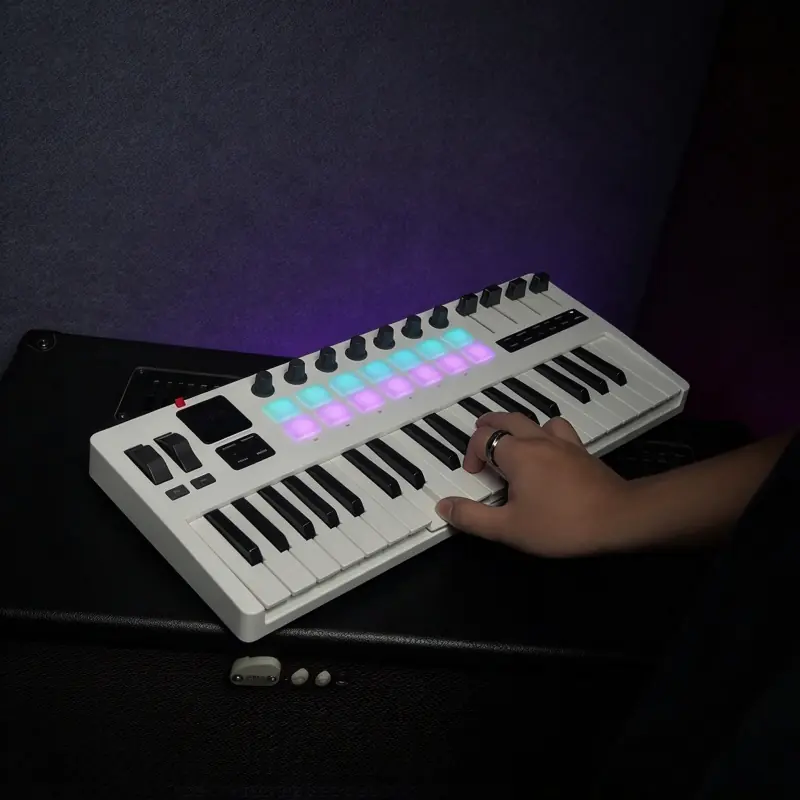
16 RGB pads
FM engine
Bluetooth MIDI
37
KEYS
16
RGB PADS
8
PATTERNS
1.54"
DISPLAY
WHERE A DESK STARTS TO FEEL SMALL
Three boxes, three cables, one idea
Most home setups grow sideways: a keyboard on the left, a pad controller on the right, a mouse in between. The idea is usually gone before everything is armed.
01 / REACHING
Every filter tweak costs you the keys
A mouse breaks the phrase. Eight encoders and four faders keep the edit under your hands while the notes are still going out.
02 / SPLIT DESKS
A second unit means a second place to look
Keys on one side, pads on the other, and your eyes keep swinging between two screens. One surface holds the keyboard, the pads and the transport.
03 / LOST IDEAS
The part you liked is gone by the time you save it
Eight pattern slots capture the phrase on the spot, without opening a second project to keep the idea alive.
THE LAYOUT
Everything in arm’s reach
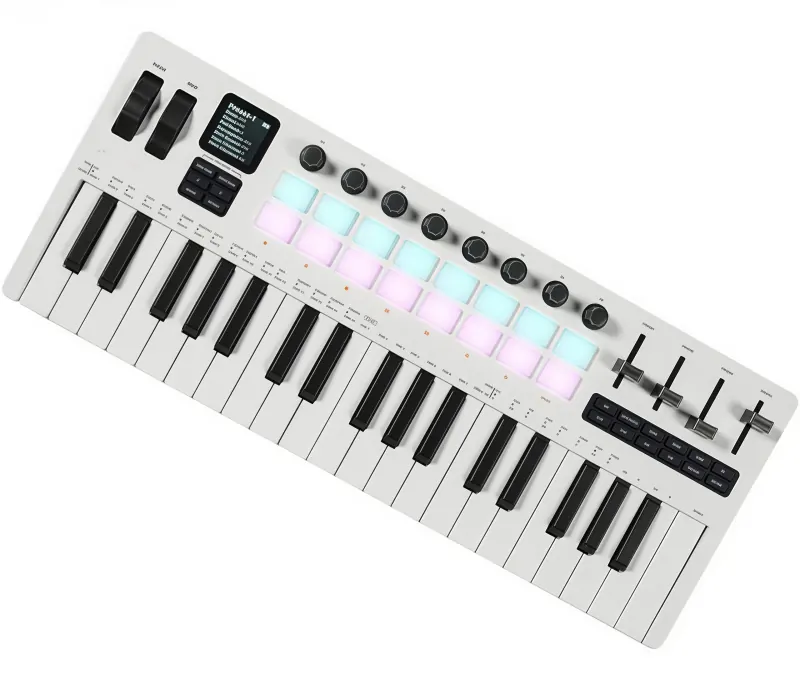
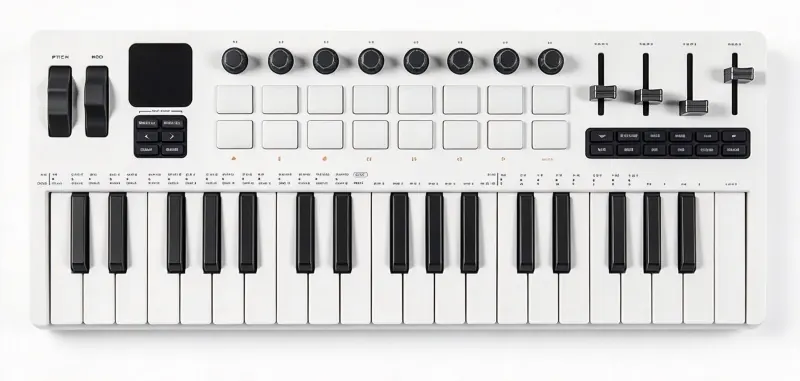
Keys low, pads and encoders above them, faders within a thumb sweep, and a screen small enough to read at a glance. Nothing on the top panel needs a second reach.
37 keys · 16 pads · 8 encoders · 4 faders · pitch and mod wheels
HOW IT PLAYS
Three layers of control
The keys are an instrument, the pads are a drum machine, and the encoders are the mixer. All three feed the same engine, so nothing has to be re-patched mid-session.
01
Velocity-sensitive keys
Three octaves read how hard you play. Soft passages stay quiet, chords land with weight, and the velocity curve carries into the FM engine as modulation depth.
02
Pads that track pressure
Sixteen pads respond to velocity and to aftertouch, so a held pad can bend a sample instead of just triggering it. The RGB layer shows pad state at a glance.
03
Hands-on mixing
Eight 360° encoders stay in step with the value you turn to, and four faders cover a bank of eight parameters. Pitch and mod wheels sit beside the keys.
37
KEYS
16
PADS
8
ENCODERS
8
PATTERNS
THE SOUND ENGINE
Four starting points for FM
The FM engine is already inside the controller, so a patch can be auditioned without a second box. Pick a family to see the settings that get you closest, then push the encoders from there.
Sub bass
Low ratio, heavy modulation and a fast decay on the operator stack. Played softly it stays round; dig into the keys and the harmonics open without clipping.
High
FM DEPTH
Fast
ATTACK
Bass lines
BEST FOR
Lead
Brighter stack with a short release so repeated notes separate cleanly. The mod wheel handles the bite; the encoders handle the ratio and the feedback.
Medium
FM DEPTH
Short
RELEASE
Hooks
BEST FOR
Pad
Wide ratios and a long attack, so chords swell in instead of landing hard. Aftertouch on the pads can add a second layer while the keys hold the harmony.
Low
FM DEPTH
Long
ATTACK
Chords
BEST FOR
Electric keys
A short, percussive stack that behaves like a tine piano. Velocity does most of the work: light playing gives a bell-like top, harder playing adds body.
Moderate
FM DEPTH
Percussive
ATTACK
Comping
BEST FOR
16 RGB PADS
A drum machine sitting above the keys
Sixteen pads read both velocity and aftertouch, so a kick can be answered with a rim shot at half the pressure and a held pad can shape a sample while it rings. Colour tells you what the pad is doing before you hit it.
16 backlit pads · velocity and aftertouch · colour by function
PAD LIGHTING
Four ways the grid can read
The backlight is not decoration. Each mode tells you a different thing about the pad under your finger. Switch below and watch the grid change.
Velocity mode: brightness follows how hard the pad is struck, column by column, so a soft ghost note looks different from a full hit.
Pressure mode: the grid turns teal and deepens with aftertouch, showing how far a held pad has been pushed.
Fixed mode: every pad sits at one level. Best for dark stages where you only need to see the layout.
Off: backlight dark, pads still respond. Useful on battery-sensitive sessions and quiet rooms.
ENCODERS AND FADERS
Eight knobs that keep up with the value
The encoders turn a full 360° with no end stop, and they follow the parameter instead of jumping when you cross its value. Four faders hold the mix; bank switching hands them eight parameters.
8 assignable encoders · 4 faders · value tracking without jumps
BANK SWITCHING
Four faders, eight parameters
Flip the bank and the same four faders now write to a second set of destinations. The physical throw stays the same, which is what makes a four-fader surface feel larger than it is.
CUTOFF
PAN
RESONANCE
SEND
ATTACK
RATE
DECAY
DEPTH
SEQUENCER & ARPEGGIATOR
Eight patterns, held in the unit
Store up to eight patterns and recall them from the panel. The arpeggiator builds runs from held chords, note repeat keeps a rhythm steady, and the screen shows which slot is playing without a laptop open.
01
EMPTY
02
EMPTY
03
PLAYING
04
EMPTY
05
EMPTY
06
EMPTY
07
EMPTY
08
EMPTY
Pattern slots hold the sequence itself. Audio still lands in your DAW or the host device over USB-C or wireless MIDI.
CONNECTIVITY
USB-C, Bluetooth MIDI, or both
One cable to a computer, or wireless MIDI to a phone or tablet across the room. MIDI out, audio out and a sustain pedal input cover the rest, so the controller can sit in the middle of a setup instead of at the edge of it.
Wired to a laptop or wireless to a tablet · MIDI out · audio out · sustain input
C1
USB-C
Power and MIDI over one cable. The most stable route for a studio desk and for units chained through a USB hub.
C2
Bluetooth MIDI
Pair with a tablet or phone and play without a cable across the desk. Useful for sketching away from the computer.
C3
MIDI out, audio out, sustain
Send MIDI to a hardware synth, monitor through the audio output, and plug a sustain pedal into the input on the back.
SPECIFICATIONS
Full specification
PRODUCT TYPE
MIDI keyboard controller with FM synthesizer
KEYBOARD
37 velocity-sensitive keys
KEY RANGE
3 octaves
DRUM PADS
16 RGB backlit pads, velocity and aftertouch
DISPLAY
1.54-inch screen
ROTARY CONTROLS
8 assignable 360° encoders
FADERS
4 assignable, expandable to 8
PERFORMANCE
Pitch and modulation wheels
BUILT-IN
FM synthesis, sequencer, arpeggiator, note repeat
SEQUENCER MEMORY
Up to 8 patterns
CONNECTIVITY
USB-C, Bluetooth MIDI
EXTRA PORTS
MIDI output, audio output, sustain pedal input
DIMENSIONS
458 × 181 × 50 mm
Bluetooth MIDI requires a host device that supports wireless MIDI. Pair from the host, then select the controller as the MIDI input.
WHAT IS IN THE BOX
Cable in, play out
The controller arrives ready to connect. Plug the bundled USB cable into the host, or pair over Bluetooth if the host supports it, and the keys are already mapped.
37 keys · pad bank · encoder row · fader bank · pitch and mod wheels
✓
37-key MIDI keyboard controller
1 unit
✓
USB connection cable
1 piece
✓
User manual
1 copy
WHO IT SUITS
A first controller, or a third one
The layout is readable enough for a first rig and deep enough that it stays on the desk after the setup grows.
Bedroom desk · small stage · rehearsal room
Beat makers
Pads for programming, keys for the chord that sits under it, and a pattern slot to keep the idea before it drifts.
Producers on a laptop
Encoders and faders keep the mix under your hands, so automation and auditioning do not need the mouse.
Live players
Eight stored patterns, an arpeggiator and a screen small enough to read in low light, on a 458 mm footprint.
OWNER FEEDBACK
What players report
Notes from bedroom studios, rehearsal rooms and small stages.
4.8
★★★★★
2,146 ratings
5 star
80%
4 star
14%
3 star
4%
2 star
1%
1 star
1%
94%
WOULD RECOMMEND
408
WITH PHOTOS
AR
Alex R.
Bedroom producer · home studio
★★★★★ 5.0
I replaced a keys-only controller and a separate pad unit with this, and the desk finally has room. The encoders follow the value instead of snapping to it, which matters more than I expected when I am riding a filter under a chord. Eight pattern slots means a loop can be sketched without opening the laptop at all. Two months in, no missed notes and no driver issues on USB-C.
✓ VERIFIED PURCHASE · 2 months ago
NT
Nia T.
Beat maker · small club sets
★★★★★ 5.0
The pads are the part I use most. Aftertouch on a held pad lets me roll a sample without reaching for a second control, and the lighting tells me what is armed before the downbeat. On stage I run it wireless off a tablet and there has been no dropout in three sets. The screen is small, but it is readable at arm’s length in a dark room.
✓ VERIFIED PURCHASE · 4 months ago
FM
Felix M.
Composer · DAW workflow
★★★★☆ 4.0
The FM engine is a genuine surprise on a controller at this level. I use it to audition parts before committing them to the project, then map the same encoders to the soft synth. Three octaves is enough for most chords but not for wide voicings, so I keep a second keyboard for those. For sketching, it is the only thing on my desk I touch.
✓ VERIFIED PURCHASE · 3 months ago
JK
Jordan K.
Rehearsal room · verified buyer
★★★★☆ 4.0
Works exactly as described, and the fader bank switch is quicker to reach than I thought. Docking a star because the keybed feels lighter than my older board, and heavy playing wants a firmer return. The pads carry the performance side for me, so it has stayed on the desk.
REPLY FROM SUPPORT
Thanks for the detail on key weight. The velocity curve can be adjusted from the settings screen, and raising it makes light touches sit lower so the top of the range feels firmer. If you want, we can send the recommended curve for pad-heavy playing.
MORE NOTES FROM THE DESK
SR
Sana R.
First controller
★★★★★ 5.0
Set up in ten minutes on a phone with wireless MIDI. Nothing to install beyond the host app.
DL
Dee L.
Live set · synth pop
★★★★★ 5.0
Eight stored patterns is the whole reason I bought it. Soundcheck takes half the time now.
HC
Hugo C.
Home studio · mixing
★★★★★ 5.0
Four faders on two banks is more useful than eight faders on one. Switching is instant.
IP
Iris P.
Songwriting · practice
★★★★★ 5.0
Light playing on the keys is expressive enough for demos. The pads are quiet under the fingers.
MB
Marco B.
Rehearsal room
★★★★★ 5.0
Sustain pedal input was the detail that sold me. It sits next to my expression pedal without a hub.
EA
Eve A.
Teaching · small classes
★★★★★ 5.0
The screen is easy to read across a music stand. Students find the pattern recall quickly.
BEFORE YOU CONNECT
Questions from the desk
Yes, through Bluetooth MIDI with a host that supports wireless MIDI. Pair from the host device, then select the controller as the MIDI input. USB-C also works with devices that accept a USB MIDI class device.
No. The pads, arpeggiator, note repeat and the eight pattern slots run in the unit itself. A host is only needed to receive the MIDI data and render audio in your software.
They cover eight parameters through bank switching, so a four-fader surface can reach the same destinations without doubling the physical width. The trade is a bank flip instead of a second throw.
Yes. Sound parameters are adjustable from the panel, and the encoders can be assigned to the ones you reach for most. Four families are shown above as starting points rather than fixed presets.
The unit measures 458 × 181 × 50 mm, so it sits under a laptop riser and beside a monitor without crowding the mouse. Three octaves keep it narrow enough for a single shelf.
The controller, one USB connection cable and a user manual. A sustain pedal and a MIDI cable for external gear are not included, since both depend on the rest of your setup.
37-key MIDI controller with FM synthesis and 16 RGB pads. Check host compatibility before pairing.