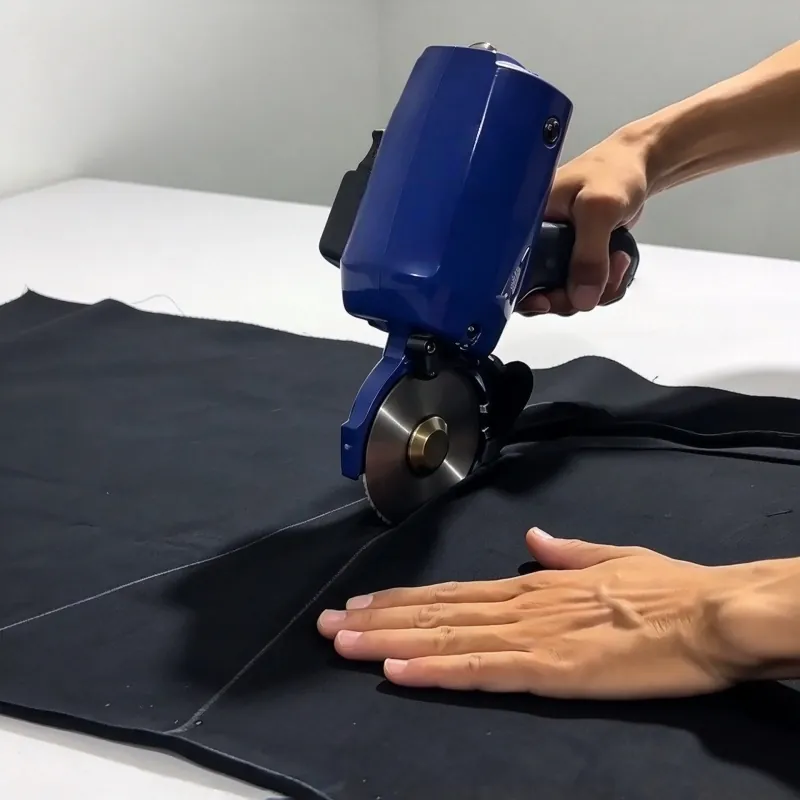
✂️ Electric Round Knife Fabric Cutting Machine – Stable Base for Precise Textile Cutting
$44.68 USD
Limit: 1 item per order
Due to our shipping policy, each order is limited to 1 item. If you would like to purchase multiple items, please place separate orders.
TEXTILE CUTTING / 100 W
One clean passthrough 25 mm
A 100 mm circular blade rides on a flat base plate, so the fabric stack stays still and the cut stays straight. Built for garment workshops, textile rooms and home sewing tables.
100 mm blade
25 mm height
Semi-automatic
110V / 220V
100 mm
BLADE
25 mm
STACK HEIGHT
100 W
MOTOR
WHERE HAND SHEARS STOP
The stack is not the problem. The squeeze is.
Scissor-style cutting relies on closing force in your hand. Past a few layers the blade starts to push the fabric instead of slicing it, and every correction shows up on the pattern.
01 / STALLING
Eight layers and the blade starts chewing
Hand shears need a fresh squeeze for every centimetre. Dense fabric fights back, so the blade snags, lifts the stack and leaves a ragged edge behind.
02 / DRIFT
The line wanders away from the pattern
Pressure changes between your fingers and thumb, so the cut curves slightly with every stroke. Two identical pieces no longer match at the seam.
03 / FATIGUE
A full table of navy wool outlasts your wrist
Long runs of the same motion tighten the forearm. Speed drops in the second hour, and the last panels are always the least accurate.
HOW IT CUTS
Three parts, one straight line
Nothing here depends on how hard you press. The machine holds the blade at a fixed height and lets the plate travel across the cloth.
01
A blade that keeps turning
The 100 mm disc rotates continuously, so each point of the edge meets the fabric at speed. That is a slice rather than a squeeze, which is why dense layers separate instead of compressing.
02
A plate that holds the height
The flat base rests on top of the stack and sets the depth for you. Keep the plate level and the blade cannot dive deeper on one side of the cut.
03
A motor that does not sag
100 W keeps the disc spinning at a steady rate under load, so speed stays constant from the first panel to the last metre of the roll.
BASE PLATE
Full contact, from the first to the last layer
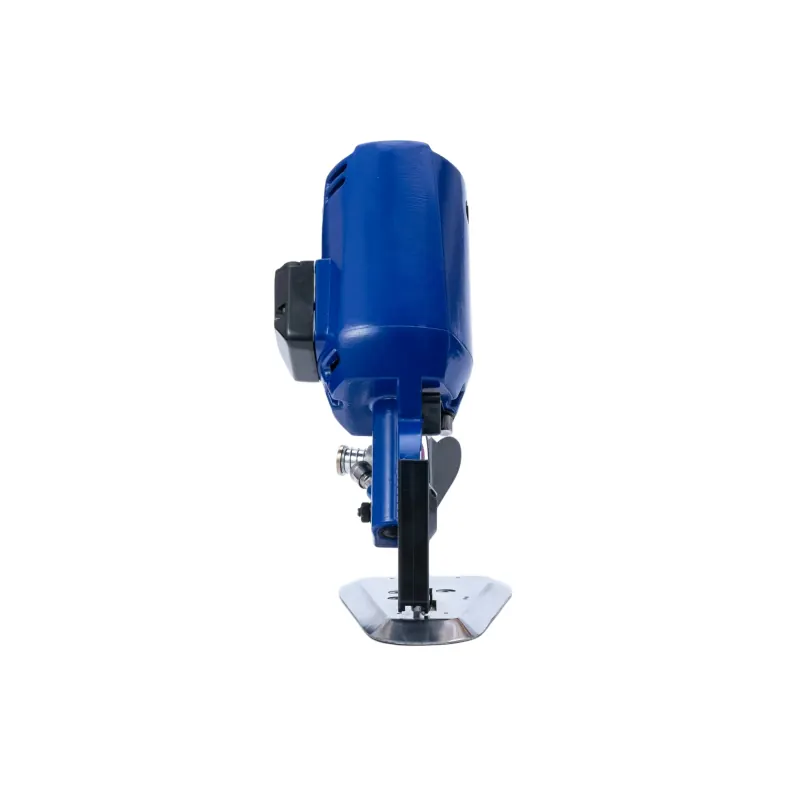
The plate is wide enough to sit flat across folded fabric and short enough to turn at the end of a pattern. The machine follows the table instead of tipping into the cloth.
Flat base plate · front blade guard · single-hand grip
25 mm
MAX HEIGHT
100 mm
BLADE
100 W
MOTOR
50/60
Hz
THE CUT EDGE
The blade does the measuring
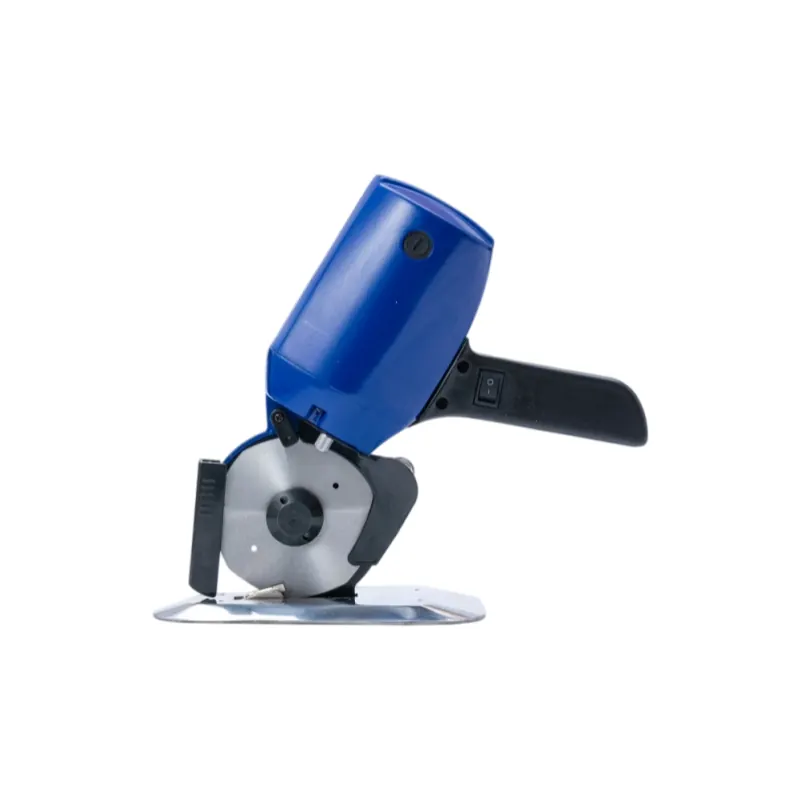
A deep disc means a short contact point and a shallow entry angle, so the edge meets the cloth at almost the same angle on a straight panel and on a curve. The cut does not need to be steered by hand pressure.
100 mm circular blade · guarded arc · side handle
MATCH THE MATERIAL
Pick your fabric, see how it runs
The same blade handles all of them. What changes is the stack you build and the pace you move at. Tap a material to read the working notes.
Cotton & canvas
The easiest material to stack. Fold flat, square the edges on the table and let the plate ride the top layer. Steady forward pressure is enough; no need to slow down at the fold.
Up to 25 mm
STACK
Medium
PACE
Rarely
SNAGS
Wool & blends
Wool shifts as it releases tension. Pin the stack with your flat hand well behind the blade and cut in one direction rather than back and forth, so the layers do not slide.
15 - 25 mm
STACK
Steady
PACE
Low
SNAGS
Linen
Linen frays at a blunt edge, so sharpen before a long run. Keep the stack shallow and let the blade finish each cut before you lift the plate.
10 - 18 mm
STACK
Moderate
PACE
Sharp edge
KEY
Silk & chiffon
Thin material is the case for the base plate: it holds the fabric flat and stops the edge from lifting it. Use a paper underlay, cut with the grain and keep the stack low.
5 - 10 mm
STACK
Slow
PACE
Underlay
RECOMMENDED
Chemical fibre
Synthetic cloth can melt at a friction point if the blade dulls. Keep it sharp, move at a moderate pace and do not let the disc sit and spin in one place.
10 - 20 mm
STACK
Moderate
PACE
Keep sharp
KEY
SHARPENING
Sharpen without putting it down
A sharpening wheel sits inside the housing. With the blade turning, a short turn of the knob brings the abrasive edge into contact and refreshes the disc in a few seconds, so a long run does not end on a dull blade.
A deep disc with a shallow entry angle, so folds and curves take the same pass.
02
25 mm stack
Handles a folded stack up to 25 mm high without lifting or compressing it.
03
100 W motor
Keeps blade speed steady through dense wool, denim and canvas.
04
Five fibre types
Cotton, wool, linen, silk, chemical fibre, plus blends of each.
05
Built-in sharpener
Refresh the edge mid-job with the knob, no second tool or bench stop.
06
Stable base
A flat plate that stays level so the cutting line does not drift.
IN THE CUT ROOM
Hands stay behind the line
The plate leads and the blade follows. Your flat hand rests well back on the stack and only guides; it never pushes the cloth into the disc. That is what keeps a full table of panels identical.
Base plate leading the cut · guide hand clear of the blade path
SPECIFICATIONS
Full specification
PRODUCT TYPE
Electric round knife fabric cutting machine
BLADE DIAMETER
100 mm (4 in)
MAX CUTTING HEIGHT
25 mm
MOTOR POWER
100 W
VOLTAGE
110V / 220V
FREQUENCY
50Hz / 60Hz
OPERATION
Semi-automatic
SUITABLE MATERIALS
Cotton, wool, linen, silk, chemical fibre and other fabrics
COLOUR
Dark blue
Check the rating plate on the unit before connecting power. Match the voltage and frequency of your supply.
WHAT IS IN THE BOX
Consumables included, not sold separately
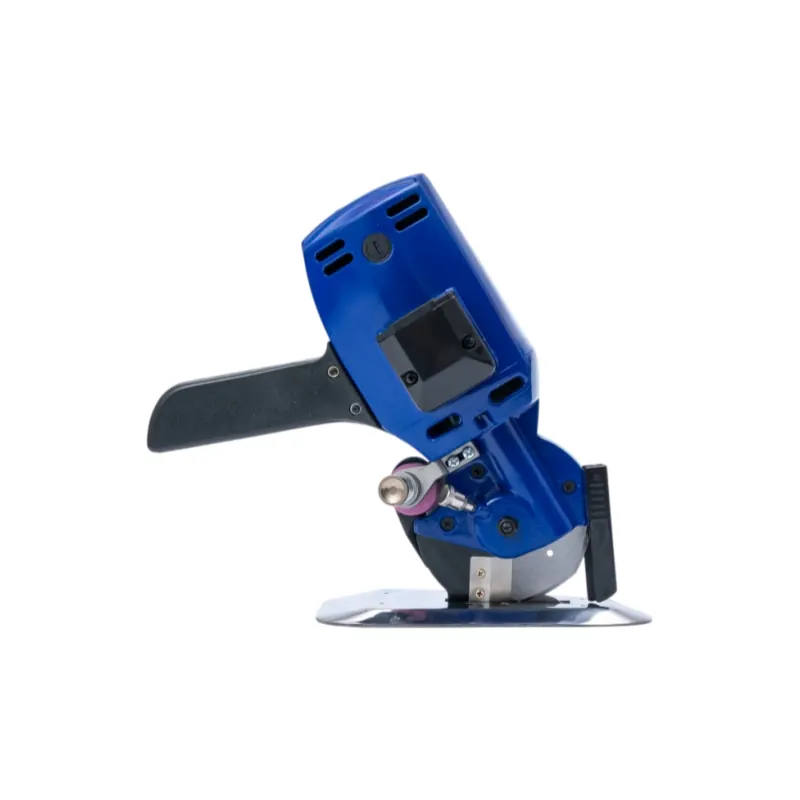
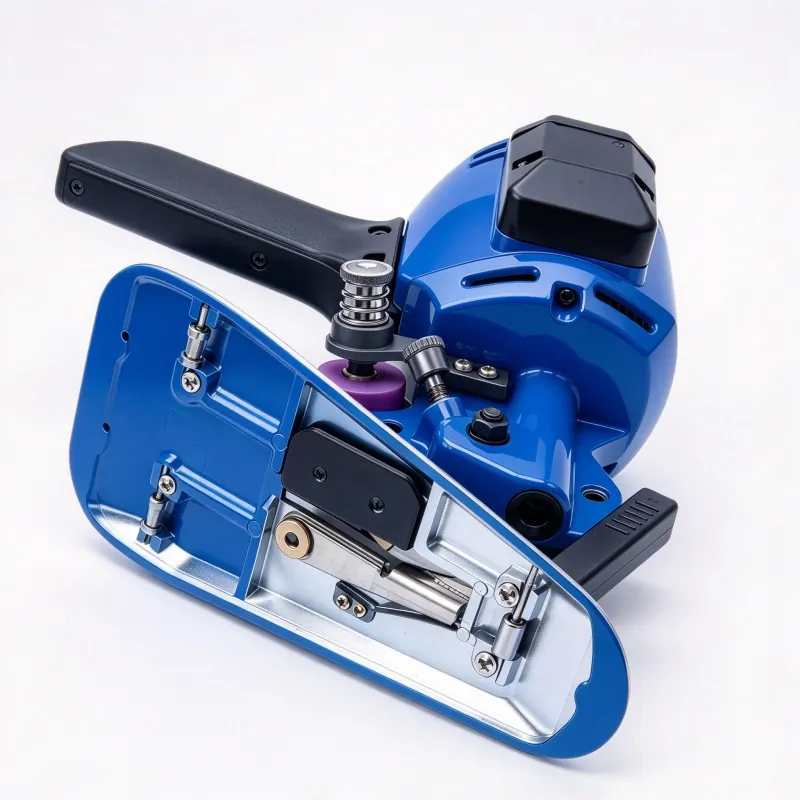
The parts that wear are already in the case: a spare blade, carbon brushes and the oil syringe for the base. Nothing to order before the first cut.
Base underside · brush housing · lubrication access
✓
Electric round knife machine
1 unit · dark blue
✓
Replacement blade
1 piece · 100 mm
✓
Carbon brush pair
1 pair · motor wear part
✓
Blade sharpener
1 piece · abrasive wheel
✓
Oil injection syringe
1 piece · base lubrication
✓
Power cord
1 piece
✓
User manual
1 copy
CUT ROOM FEEDBACK
What operators report
Long-run notes from small workshops, wardrobe departments and home sewing rooms.
4.7
★★★★☆
1,284 ratings
5 star
78%
4 star
16%
3 star
4%
2 star
1%
1 star
1%
96%
WOULD RECOMMEND
312
WITH PHOTOS
MD
Marcus D.
Cut room lead · garment workshop
★★★★★ 5.0
We run about forty garments a week, mostly navy wool and mid-weight denim, and the stack was the bottleneck. Six to eight layers used to take three passes with shears and still needed trimming. The plate sits flat and the cut comes off square on the first pass, so the trimming bench has almost nothing to do now. The sharpening knob gets used between rolls and it takes seconds rather than a trip to the grinder.
✓ VERIFIED PURCHASE · 3 months ago
ER
Elena R.
Wardrobe supervisor · theatre production
★★★★★ 5.0
Costume work means small stacks of very different cloth and a lot of curved seams, which is exactly where shears gave us trouble. The base plate keeps chiffon flat long enough to get through it, and curved pieces come out without the wobble we used to fix by hand. We sharpen before each show call and the edge holds through the whole run. The only thing to learn is to let the plate do the work instead of pushing.
✓ VERIFIED PURCHASE · 5 months ago
PS
Priya S.
Home sewer · quilting and patchwork
★★★★☆ 4.0
On a domestic table this replaced a rotary cutter and a lot of hand pressure, and my shoulder noticed the difference in the first week. Quilt batting and layered cotton go through cleanly. It is a bench tool rather than a portable one, so wide backing panels still need a second person to hold the far edge. For the panels I do alone it is quick and accurate.
✓ VERIFIED PURCHASE · 2 months ago
TB
Tom B.
Upholstery workshop · verified buyer
★★★★☆ 4.0
Cut quality is good and the sharpener is genuinely useful mid-job. Docking one star because the housing is chunky to hold one-handed at the end of a long table, and heavy canvas needs two passes anyway to stay square. A longer plate would suit my bench better.
REPLY FROM SUPPORT
Thank you for the detail on canvas. For dense stacks, work in two passes on the same line rather than one deep pass, and keep the plate flat against the second layer. If the grip feels long, the side handle can be run closer to the body while the free hand stays on the fabric well behind the blade.
MORE NOTES FROM THE TABLE
AK
Aria K.
Apparel student
★★★★★ 5.0
First day I put twelve layers of canvas under it and the line did not drift once.
JP
Jon P.
Tailor · alterations
★★★★★ 5.0
The sharpening knob works while it runs. That alone saves me a trip to the back room.
ML
Mei L.
Costume assistant
★★★★★ 5.0
Silk did not snag once as long as I kept the layers flat and moved slowly.
DW
Dana W.
Home sewing room
★★★★★ 5.0
Replaced a set of shears and an aching wrist in one order. Should have done it sooner.
OH
Owen H.
Textile production
★★★★★ 5.0
The oil syringe in the case was a nice detail. Base runs smooth after a few drops.
SR
Sam R.
Workwear factory
★★★★★ 5.0
Carbon brushes and a spare blade were included, so nothing to reorder in the first season.
BEFORE YOU CUT
Questions from the bench
Yes. The base plate sets the depth, so a stack up to 25 mm can be passed in one go. Very dense material such as heavy canvas is more accurate in two passes on the same line than in one deep pass.
It will, with the plate on the fabric. Thin cloth is the usual reason a blade lifts the material instead of cutting it, and a flat plate prevents that. Keep the stack low, use a paper underlay and move at a slow, even pace.
An abrasive wheel is mounted inside the housing. With the blade running, a short turn of the knob brings the wheel against the cutting edge. A few seconds is enough to refresh the disc, and it can be repeated between rolls without removing the blade.
Regular sharpening keeps an edge for a long time. Replace the blade when the disc no longer holds an edge after a sharpening pass, or when the cut starts to pull the fabric. A replacement blade is already in the case.
It is a bench machine, so the first skill to learn is positioning rather than force: plate flat on the cloth, guide hand well behind the blade path, one direction per cut. The blade is guarded at the front and the unit is switched off and unplugged before any blade change.
The unit is offered in 110V and 220V versions at 50Hz or 60Hz. Match the rating plate on the machine to your local supply before connecting it for the first time.
Semi-automatic electric round knife for textile work. Read the manual before the first cut.