Due to our shipping policy, each order is limited to 1 item. If you would like to purchase multiple items, please place separate orders.
LIGHT REFERENCE / CCT + CRI
Warm, cool, and what the eye skips
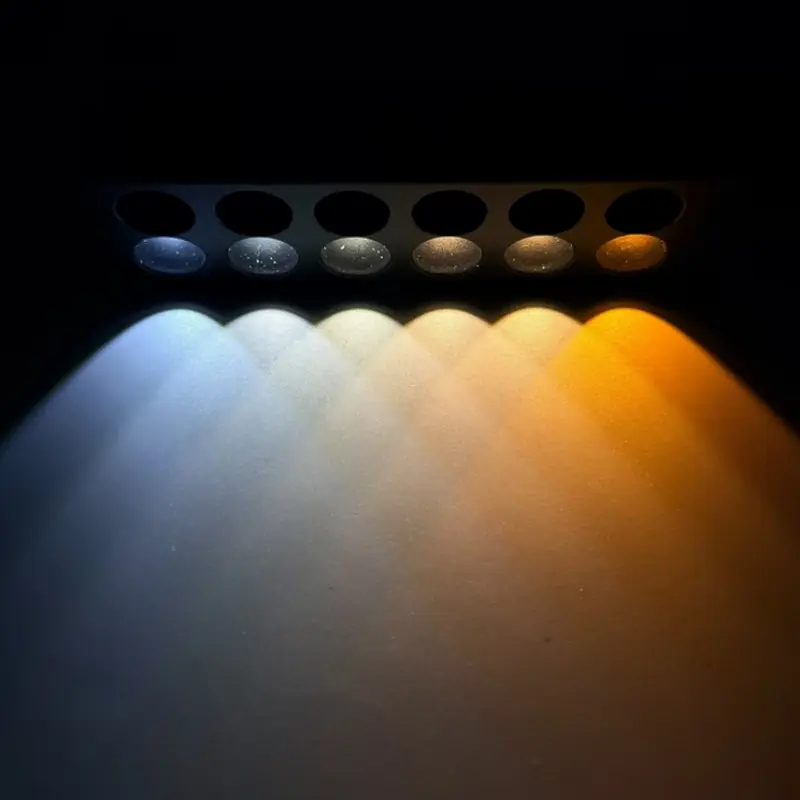
A two-sided reference wand: one face projects six fixed colour temperatures, the other five rendering levels. Hold it against the light you are judging and compare, instead of trusting a memory of what white should look like.
2200–6500K
5 CRI levels
UV 265nm
USB-C
6
CCT PRESETS
5
CRI LEVELS
265
NM UV
600
mAh CELL
WHY THE EYE IS A POOR JUDGE
You adapt before you can compare
Colour temperature is judged relative to whatever the eye last settled on. Stand in a warm room for ten minutes and it starts to read as neutral, which is why two rooms can feel the same and photograph nothing alike.
01 / ADAPTATION
Ten minutes in and the room looks white
The eye rebalances. A 3000K lamp and a 4000K panel both settle into “normal” once you stop moving between them, so a slow walk through a building never shows the mismatch.
02 / THE CAMERA LIES
A phone corrects the evidence away
Automatic white balance pulls every shot toward grey, and the screen adds its own cast on top. A photo can confirm a decision that the room does not actually support.
03 / NO FIXED POINT
Warm and cool need something to stand against
Two lights side by side still tell you nothing if neither is known. A reference with fixed values turns the comparison into a check rather than an opinion.
TWO FACES, ONE BODY
Which face you hold decides what you see
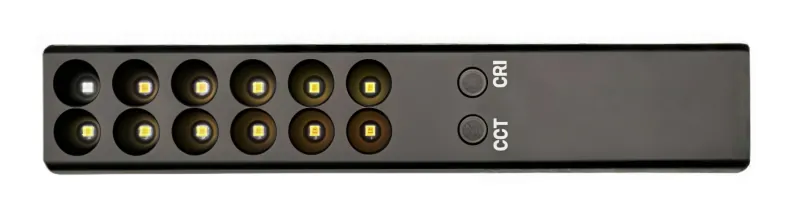
The wand carries both test functions on opposite sides, so a session does not need a second instrument or a bag of filters. Flip it, and the same button row switches to the other set of presets.
SCHEMATIC · LED ROW ON EACH FACE
SIDE A
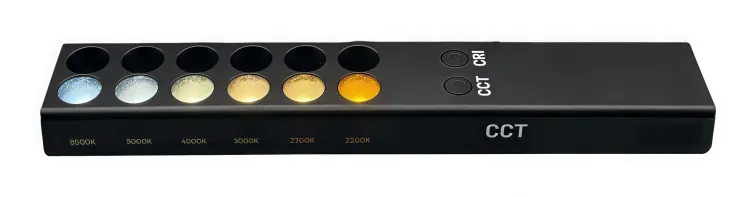
2200K / 2700K / 3000K / 4000K / 5000K / 6500K — six white references on one face.
SIDE B
60Ra / 70Ra / 80Ra / 90Ra / 98Ra — five rendering references on the other.
SHARED
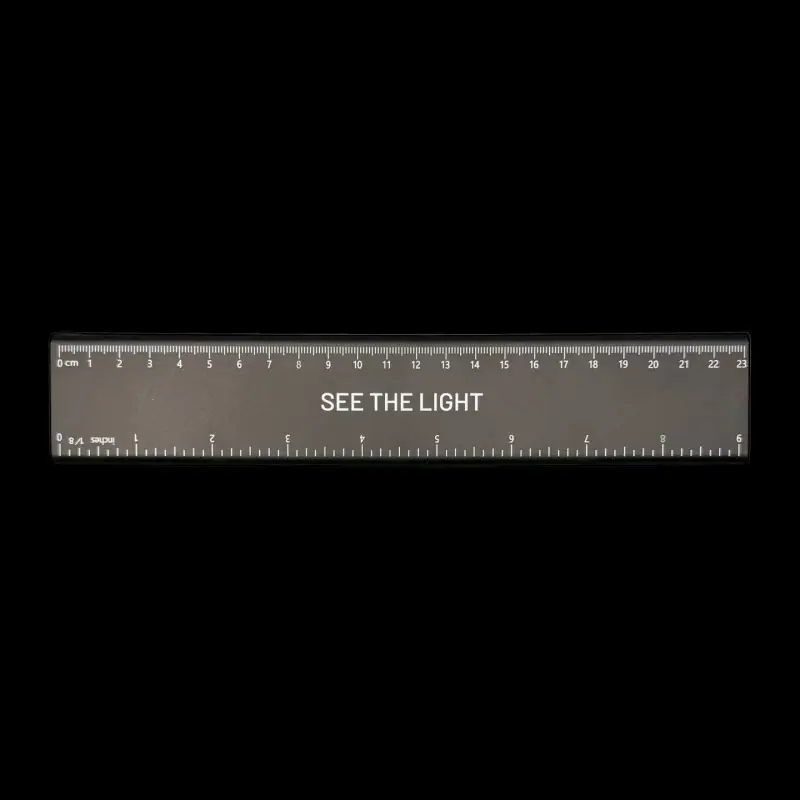
One button row, one 600mAh cell, one USB-C port. The body measures 235 × 35 mm.
WHAT YOU HOLD
A reference that fits beside the fixture
At 235 × 35 mm it goes where a meter will not: against a shelf, under a cabinet, inside a display case. The slim body sits flat on a surface so the light lands on it the way it lands on the material being judged.
Slim wand body · preset row on the edge · single-hand operation
COLOUR TEMPERATURE
Six stops from candle to daylight
Each preset is a fixed white reference rather than a dimmable output. Pick the level closest to the light you are checking, put both on the same surface, and the direction of the difference becomes obvious.
2200K
2700K
3000K
4000K
5000K
6500K
2200 K
Candle and filament warm
Deep amber, the colour of a low filament lamp. Useful for checking hospitality lighting and heritage interiors, where a neutral reference would look wrong rather than helpful.
Very warm
TINT
Accent
TYPICAL USE
High
CONTRAST
2700 K
Domestic warm white
The default of most household lamps. Put it beside a new bulb and a 300K drift is easy to spot, which matters when a replacement does not match the rest of the room.
Warm
TINT
Living
TYPICAL USE
Medium
CONTRAST
3000 K
Retail and hospitality
A slightly lifted warm white. Common over counters and in cafes where warm light is wanted without the amber heaviness of 2700K. Good for checking whether a shop floor is consistent.
Warm neutral
TINT
Retail
TYPICAL USE
Medium
CONTRAST
4000 K
Neutral working light
The middle of the range and the usual reference for offices, workshops and task lighting. If a room is meant to read as neutral, this is the level to hold it against.
Neutral
TINT
Workspace
TYPICAL USE
Low
CONTRAST
5000 K
Cool white, showroom crisp
Reads clean and slightly blue. Used over displays and in spaces where product colour has to look crisp. Compare here when a fixture is said to be daylight but seems flat.
Cool
TINT
Display
TYPICAL USE
Low
CONTRAST
6500 K
Daylight, overcast
A blue-leaning reference that matches overcast daylight. Held beside a 4000K fixture it shows immediately how cool that fixture is not, which is the usual gap in a daylight claim.
Coolest
TINT
Daylight
TYPICAL USE
High
CONTRAST
6
CCT PRESETS
5
CRI LEVELS
265
NM UV
235
mm LONG
COLOUR RENDERING
How much of the colour survives
Two lights can sit at the same colour temperature and still make the same fabric look different. The rendering side gives five reference levels, so the fading at 60Ra and the near-full colour at 98Ra can be compared directly instead of described.
60 Ra
Heavy colour loss
Reds flatten toward brown and blues drift grey. This is the level to hold against low-cost strip lighting, where fabric on a shelf and the same fabric in daylight read as two different products.
Washed
COLOUR
Broad drift
SHIFT
Budget
FIXTURES
70 Ra
Noticeable but usable
Colours stay readable, though saturated reds still lose depth. Common in inexpensive domestic fittings. Compare it against an 80Ra reference to see whether the gap matters for the room.
Muted
COLOUR
Reds first
SHIFT
Domestic
FIXTURES
80 Ra
The everyday baseline
The level most specifications quote and most interiors settle on. Colours hold together well; a deep red or a strong blue may still lose a little intensity beside a high-rendering source.
Balanced
COLOUR
Minor
SHIFT
General
FIXTURES
90 Ra
High fidelity
Saturated tones keep their depth, which is why this level appears in galleries, fitting rooms and anywhere merchandise is being judged by eye. Reds and skin tones are the usual visible gain.
Rich
COLOUR
Near none
SHIFT
Retail
FIXTURES
98 Ra
The reference ceiling
The top level in the set, close to how the same colours behave in good daylight. Useful as the target when a specification is being written, and as the ceiling for judging everything below it.
Full
COLOUR
Minimal
SHIFT
Reference
FIXTURES
The strip above is a comparison aid on this page, not a measurement. The wand itself projects the reference light; the reading is made by eye against the surface being checked.
IN THE HAND
One thumb on the row, one face on the wall
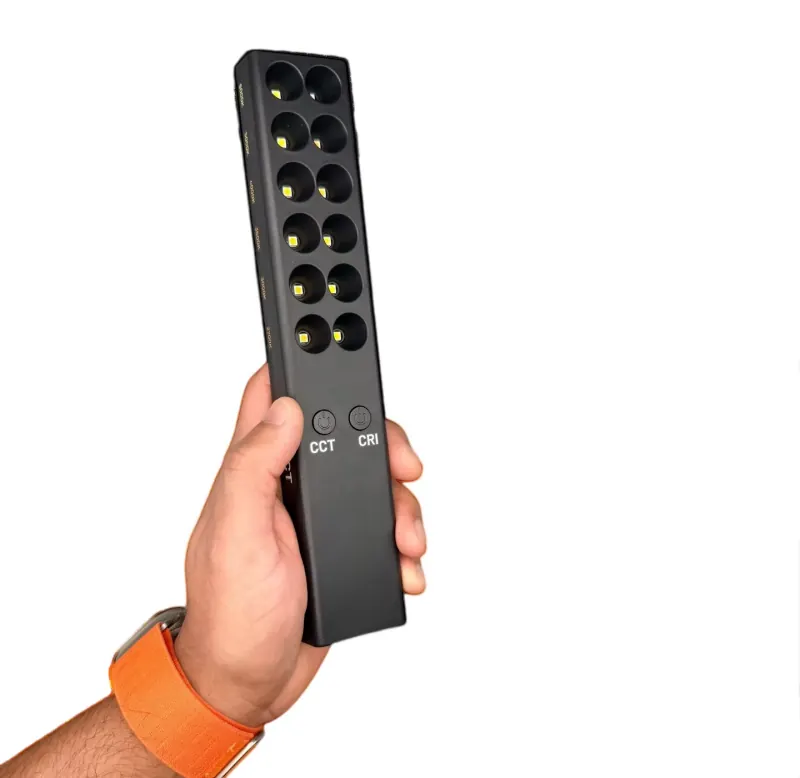
The preset row sits within thumb reach, so the level can be changed while the other edge stays against the surface. No menus, no second hand, no setting up a stand in a finished room.
Held flat against a surface · preset row under the thumb · 35 mm body
ULTRAVIOLET
A third output for surfaces
Beyond white, the wand also emits at 265 nm. That is not a lighting judgement but a surface one: it shows up UV-reactive marks, tracer inks and coatings that look uniform under ordinary light.
WHAT TO LOOK AT
Tracer inks and security marks, which sit invisible under white light.
Clear coatings and resins, where an uneven layer shows as a patch rather than a line.
UV-reactive tape and stickers used to mark installed cabling.
Do not aim the UV output at the eyes or skin, and keep it away from anyone who is not part of the inspection.
LOW LIGHT
Built to be read in a dark room
Most of the places worth checking are dim: a cinema pre-show, a bar at opening, a gallery with the track lights down. The wand's own light is the reference in those rooms, and the small body keeps it out of the way of what is being judged.
Reference output in an unlit room · preset row visible at a glance
A FOUR-SECOND CHECK
Three steps, every time
The method is deliberately short. Any longer and it stops being done on a walkthrough, which is exactly when a mismatch is easiest to fix.
01
Put the wand on the material
Hold it flat against the wall, fabric or surface you are judging, not in the air. Reflected light off a nearby object is what the eye is actually comparing.
02
Step through the presets
Start at the level you expect and move one step either way. The reference that disappears into the ambient light is the one that matches.
03
Note the gap, not the number
What matters is how far off the fixture is and in which direction. That is the note that gets a fitting replaced rather than argued over.
SIDE BY SIDE
Warm on one wall, cool on the next
Mixed colour temperature is the most common complaint in a finished interior, and the hardest to prove after the fact. A reference on the joint between two areas shows the step in one glance, with no guesswork about which fixture is wrong.
Adjacent areas at different colour temperatures · reference held at the joint
SPECIFICATIONS
Full specification
PRODUCT TYPE
2-in-1 CCT and CRI light testing wand
CCT RANGE
2200K – 6500K
CCT PRESETS
2200K / 2700K / 3000K / 4000K / 5000K / 6500K
CRI LEVELS
60Ra / 70Ra / 80Ra / 90Ra / 98Ra
UV OUTPUT
265 nm
BATTERY
600mAh built-in
CHARGING
USB-C
INPUT
5V / 1A
DIMENSIONS
235 × 35 mm
Charge from a standard 5V / 1A USB port. Runtime depends on the level used and on how long the UV output is left on.
WHAT IS IN THE BOX
Wand, cable, ready to charge
The unit arrives charged enough to test before its first full cycle. A USB-C cable is included, so any 5V phone charger in the room can top it up during a walkthrough.
Single body · both test faces on one wand · USB-C port at the base
✓
CCT and CRI light testing wand
1 unit
✓
USB-C charging cable
1 piece
OWNER FEEDBACK
What the walkthroughs say
Notes from electricians, lighting designers and shop fitters who carry it daily.
4.7
★★★★☆
1,042 ratings
5 star
79%
4 star
15%
3 star
4%
2 star
1%
1 star
1%
95%
WOULD RECOMMEND
264
WITH PHOTOS
RM
Rachel M.
Lighting designer · retail projects
★★★★★ 5.0
I specify colour temperature all day, and the gap between drawing and installation is usually the fitting, not the design. This wand settles those conversations in the aisle. The six steps are close enough that walking one up and down finds the match in seconds, and the 3000K and 4000K positions get the most use. It has replaced a much larger reference box in my bag.
✓ VERIFIED PURCHASE · 4 months ago
DT
Daniel T.
Electrician · domestic callouts
★★★★★ 5.0
Most of my jobs are “the new bulbs look different”, and the customer is right but cannot explain why. Holding this against the wall next to the old fitting shows the step straight away, no arguing. The CRI side earned its place too: a kitchen where the worktop looked grey turned out to be an 80Ra tube rather than anything wrong with the surface.
✓ VERIFIED PURCHASE · 2 months ago
SK
Sofia K.
Shop fitter · display lighting
★★★★☆ 4.0
Handy for checking a run of track heads after they are aimed, and the CRI levels are the part the merchandising team actually understands. It is a reference tool rather than a meter, so it will not give you a number to put in a report; for that I still borrow a meter. For the daily check on site it is faster than anything else I carry.
✓ VERIFIED PURCHASE · 3 months ago
GC
Greg C.
Electrical contractor · verified buyer
★★★★☆ 4.0
Does the job and the battery has lasted a full week of callouts. Docking a star because the buttons are small and I have to look twice with gloves on, and the UV output is brighter than I expected in a tight space. The white references themselves are consistent, which is what I bought it for.
REPLY FROM SUPPORT
Thank you for the note on the buttons. Holding the wand with the preset row facing you and using the pad of the thumb rather than the tip makes the smaller row easier to work with gloves. For confined spaces, angle the UV face away from the surface at about 45 degrees so the reflection does not come back at eye level.
MORE NOTES FROM SITE
LP
Lena P.
Interior designer
★★★★★ 5.0
Ended a three-month argument about whether a hallway was too yellow in about ten seconds.
AN
Amir N.
AV installer
★★★★★ 5.0
Fits in a shirt pocket, and the USB-C port means I charge it from the van like everything else.
HO
Hana O.
Gallery technician
★★★★★ 5.0
We use 3000K through the whole floor and the 98Ra step is a good sanity check before opening.
VJ
Victor J.
Facilities maintenance
★★★★★ 5.0
The UV face found tracer marks on cabling that no one had a drawing for. Paid for itself that day.
BE
Bea E.
Studio photographer
★★★★★ 5.0
Comparing a softbox against a wall is exactly what I needed. No screens involved, no colour cast from the preview.
MW
Marcus W.
Home renovation
★★★★★ 5.0
Bought it to settle which downlights to keep. Took twenty minutes for the whole house.
BEFORE YOU BUY
Questions from site
It is a reference. The wand projects fixed, known light at each preset so you can compare it against the light being judged. It does not report a numerical reading of the ambient source; if you need figures for a report, use a calibrated meter.
Start at the value you expect for the space and move one step at a time. The preset that visually merges with the surrounding light is the closest match, and the direction you had to move tells you which way the fixture is off.
Each level projects light with a different rendering character, from flat at 60Ra to close to daylight at 98Ra. Put a coloured sample under the wand and under the light being checked, then switch levels until the sample matches; the difference you had to close is the rendering gap.
That is the main use. The wand provides its own reference, so a room does not need to be lit for a comparison. In very low light, let the eye settle for a few seconds between presets rather than switching quickly.
Through USB-C at 5V / 1A from any standard charger or power bank. The 600mAh cell covers repeated checks, though runtime depends on the level used and on how long the UV output is left on, so a full charge before a long walkthrough is worth the habit.
The box contains the wand and a USB-C charging cable. No pouch is included; at 235 × 35 mm it fits a tool roll or a pocket, but keep it away from loose metal in a bag so the faces do not get scratched.
Two-sided reference wand for colour temperature and rendering. Read the manual before first use.